The Science of Efficient Kanji Acquisition: Five Evidence-Based Strategies
The empirical case for structured kanji study
2,136 joyo kanji is not a willpower problem. It is a scheduling, encoding, and retrieval problem — and each of those three has decades of controlled experiments behind it. Five strategies below. Effect sizes, not anecdotes.
1. Spaced repetition — beat the forgetting curve with an algorithm
In 1885, Hermann Ebbinghaus sat down with lists of nonsense syllables — WID, ZOF, consonant-vowel-consonant trigrams designed to carry no meaning — and measured how much relearning he could skip at seven intervals. N=1. The subject was himself. The data has held up for 140 years.
| Time since learning | Savings (%) | Memory lost (%) |
|---|---|---|
| 20 minutes | 58.2 | 41.8 |
| 1 hour | 44.2 | 55.8 |
| 8.8 hours | 35.8 | 64.2 |
| 1 day | 33.7 | 66.3 |
| 2 days | 27.8 | 72.2 |
| 6 days | 25.4 | 74.6 |
| 31 days | 21.1 | 78.9 |
Ebbinghaus, Über das Gedächtnis (1885), §29. Replicated by Murre & Dros (2015), PLOS ONE.

The forgetting curve. Red is unaided decay. Each green curve is a well-timed review flattening what comes next — the mechanical basis of spaced repetition. Source: Wikimedia Commons.
Ebbinghaus fit the decay to b = 100k / ((log t)c + k), with k = 1.84, c = 1.25. Skip review and half the material is gone within an hour. A spaced repetition system exploits the curve by scheduling the next review at the moment recall probability slides toward a target threshold — late enough to make the retrieval effortful, early enough that you still succeed.
Algorithms differ in how aggressively they model the decay. The open-spaced-repetition benchmark — 727 million reviews from 10,000 Anki collections — lets you compare them on the same data:
| Algorithm | Model | Parameters | Log loss | Superiority vs SM-2 |
|---|---|---|---|---|
| Leitner | Box-based intervals | 0 | — | baseline |
| SM-2 | Linear ease factor | 2 | 0.346 | — |
| HLR (Duolingo) | Half-life regression | 3 | 0.327 | — |
| FSRS v4 | DSR power-decay | 17 | 0.326 | 99.6% |
| FSRS-7 | DSR power-decay | 21 | 0.324 | 99.6% |
srs-benchmark, 10,000 collections. Log loss is cross-entropy between predicted recall probability and actual outcome. Lower is better.
FSRS models memory with three state variables: Stability S (days for retrievability to drop to 90%), Difficulty D (1–10), and Retrievability R. The forgetting curve is a power function — R(t, S) = (1 + t/9S)-1. After each successful review, stability updates via S' = S · (1 + ew8 · (11 − D) · S-w9 · (ew10(1−R) − 1) · hardpenalty · easybonus). Seventeen weights, fit per user via gradient descent over your own review history. MojiMori runs FSRS-5 natively in the review system.
2. Retrieval practice — the test is the encoding event
Roediger and Karpicke (2006) split 120 undergrads three ways on prose passages: four study periods (SSSS), three study plus one test (SSST), one study plus three tests (STTT). At five minutes, SSSS won (83% recall vs 71%). At one week, the order inverted: STTT held 61%, SSSS collapsed to 40%. The test was not measurement. The test was the encoding event.
Rowland's 2014 meta-analysis of 159 comparisons pinned the testing effect at Hedges' g = 0.50 (95% CI: 0.42–0.58). Medium-to-large, robust across conditions. For kanji, "active recall" means producing "water" when shown 水 — not reading "水 = water" forty times. Our study sessions run four retrieval directions: meaning, reading, glyph-from-meaning, glyph-from-reading. The asymmetry is the point — recognizing a kanji and producing it are different skills, exercised separately.
3. Motor encoding — write it by hand
Longcamp, Boucard, Gilhodes, and Velay (2006) taught adults novel graphic characters by handwriting or typing, then tested recognition weeks later. Handwriting won — significantly stronger and longer-lasting recognition, and fMRI showed greater activation in the left fusiform gyrus and inferior frontal regions. The same circuits the brain recruits during reading.
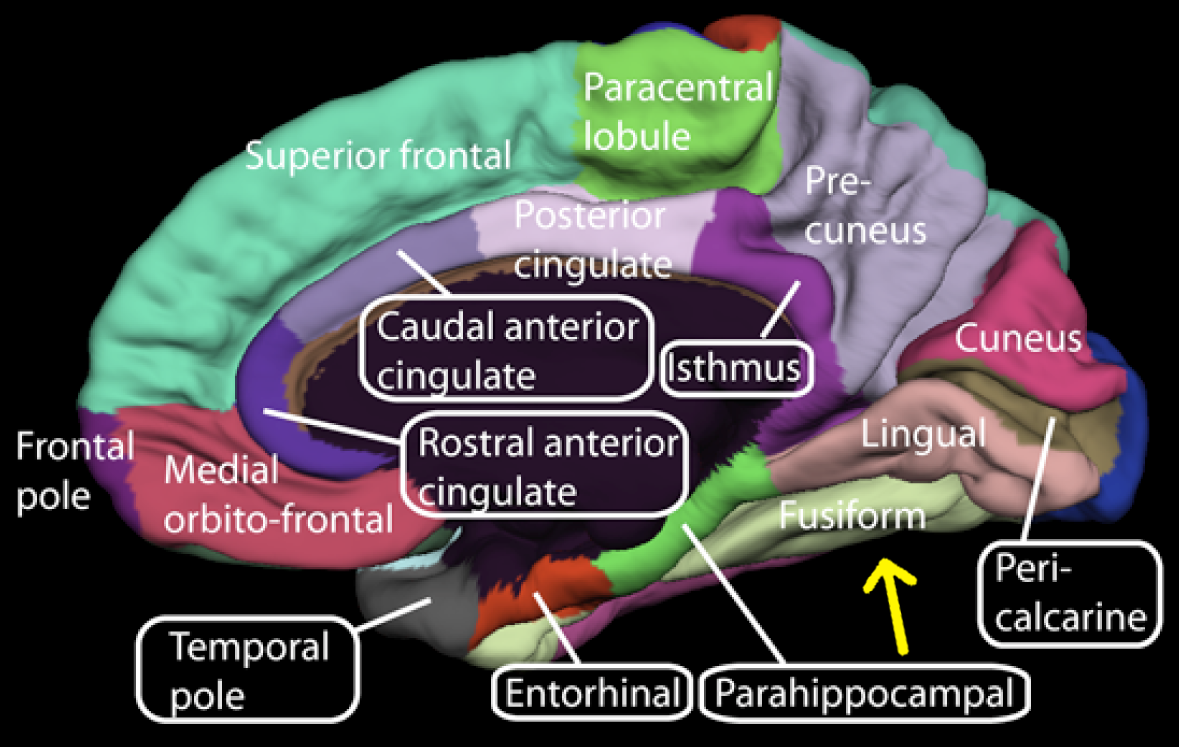
Medial view of the cerebral cortex, fusiform gyrus highlighted. The left fusiform houses the Visual Word Form Area. Longcamp et al. found it fires harder for characters learned by handwriting than by typing. Source: Wikimedia Commons.
Naka and Naoi (1995) replicated the effect on Japanese materials. Repeated writing improved free recall of graphic forms over visual-only study, strongest when encoding and test modality matched. The mechanism: the motor trace of stroke production is a second, independent retrieval cue. A few correct-stroke-order repetitions per character buy you a memory channel pure-digital study cannot reach.
4. Interleaving — mix the confusable ones
Kornell and Bjork (2008) had participants learn painting styles from twelve artists. One group studied in blocks — six paintings by artist A, then six by B, etc. The other group saw them interleaved. On a transfer test with novel paintings, interleaving hit 59% accuracy; blocking, 36%. Effect size d = 0.99. Participants reported feeling blocking worked better. Their own data said otherwise — the metacognitive illusion is part of the finding.
For kanji this maps cleanly. Study visually adjacent characters in one mixed deck — 待 (wait), 持 (hold), 特 (special), 寺 (temple) — and the discrimination becomes the work. Bjork and Bjork's desirable difficulties framework names the principle: conditions that slow initial acquisition (spacing, interleaving, retrieval) raise long-term retention by forcing deeper processing. The friction is the mechanism, not the obstacle.
5. Component decomposition — structure before memorization
Atkinson and Raugh (1975) tested the keyword method on Russian vocabulary: 72% recalled after one week with keyword mnemonics, 46% with rote. Heisig's Remembering the Kanji (1977) generalizes the move to the full joyo set by decomposing each character into recurring "primitives" and linking them through narrative imagery. No head-to-head RCT on RTK vs traditional instruction at scale, but the keyword scaffolding underneath it is one of the better-attested findings in word acquisition.
The deeper point is compositional. Roughly 200 unique components — radicals, graphemes, phonetic series — recombine across every joyo character. Learn 語 as 言 + 五 + 口, not as a fourteen-stroke monolith, and the cost function turns from O(n) memorization into O(log n) structural analysis. Every component you add pays out across dozens of future characters. The Kanji Atlas renders that graph for the entire joyo set.
Key studies summary
| Study | Year | N | Effect size | Core finding |
|---|---|---|---|---|
| Ebbinghaus | 1885 | 1 | — | Forgetting is power-law; 58% at 20 min, 21% at 31 days |
| Atkinson & Raugh | 1975 | 120 | 72% vs 46% | Keyword mnemonics beat rote at 1 week |
| Naka & Naoi | 1995 | — | sig. | Handwriting beats visual-only for graphic forms |
| Roediger & Karpicke | 2006 | 120 | 61% vs 40% | Three tests beat four study sessions at 1 week |
| Longcamp et al. | 2006 | — | sig. (fMRI) | Handwriting recruits reading circuits typing does not |
| Kornell & Bjork | 2008 | 120 | d = 0.99 | Interleaving doubles classification accuracy |
| Rowland (meta) | 2014 | 159 studies | g = 0.50 | Testing effect is robust across conditions |
| Ye (FSRS) | 2023 | 10K users | 99.6% sup. | FSRS beats SM-2 on 99.6% of collections |
Five strategies, one stack. Decompose the character into components. Write it by hand. Test yourself in interleaved sets of look-alikes. Anchor it in a real word. Let an FSRS scheduler pick the next review. Each layer adds an independent memory trace, and any one of them is enough to pull the character back.
References
- Atkinson, R.C. & Raugh, M.R. (1975). An application of the mnemonic keyword method to the acquisition of Russian vocabulary. Journal of Experimental Psychology: Human Learning and Memory, 1(2), 126–133. doi:10.1037/0278-7393.1.2.126
- Bjork, R.A. & Bjork, E.L. (2011). Creating desirable difficulties to enhance learning. In Psychology and the Real World (pp. 56–64). Worth Publishers. PDF
- Ebbinghaus, H. (1885). Über das Gedächtnis: Untersuchungen zur experimentellen Psychologie. Duncker & Humblot. English: Memory: A Contribution to Experimental Psychology (1913). Archive.org
- Kornell, N. & Bjork, R.A. (2008). Learning concepts and categories: Is spacing the "enemy of induction"? Psychological Science, 19(6), 585–592. doi:10.1111/j.1467-9280.2008.02127.x
- Longcamp, M., Boucard, C., Gilhodes, J.C., & Velay, J.L. (2006). Remembering the orientation of newly learned characters depends on the associated writing knowledge. Human Movement Science, 25(4–5), 646–656. doi:10.1016/j.humov.2006.07.007
- Murre, J.M.J. & Dros, J. (2015). Replication and analysis of Ebbinghaus' forgetting curve. PLOS ONE, 10(7), e0120644. doi:10.1371/journal.pone.0120644
- Naka, M. & Naoi, H. (1995). The effect of repeated writing on memory. Memory & Cognition, 23(4), 431–436. doi:10.3758/BF03197245
- Roediger, H.L. & Karpicke, J.D. (2006). Test-enhanced learning: Taking memory tests improves long-term retention. Psychological Science, 17(3), 249–255. doi:10.1111/j.1467-9280.2006.01693.x
- Rowland, C.A. (2014). The effect of testing versus restudy on retention: A meta-analytic review of the testing effect. Psychological Bulletin, 140(6), 1432–1463. doi:10.1037/a0037559
- Ye, J. (2023). FSRS4Anki. Benchmark: open-spaced-repetition/srs-benchmark.